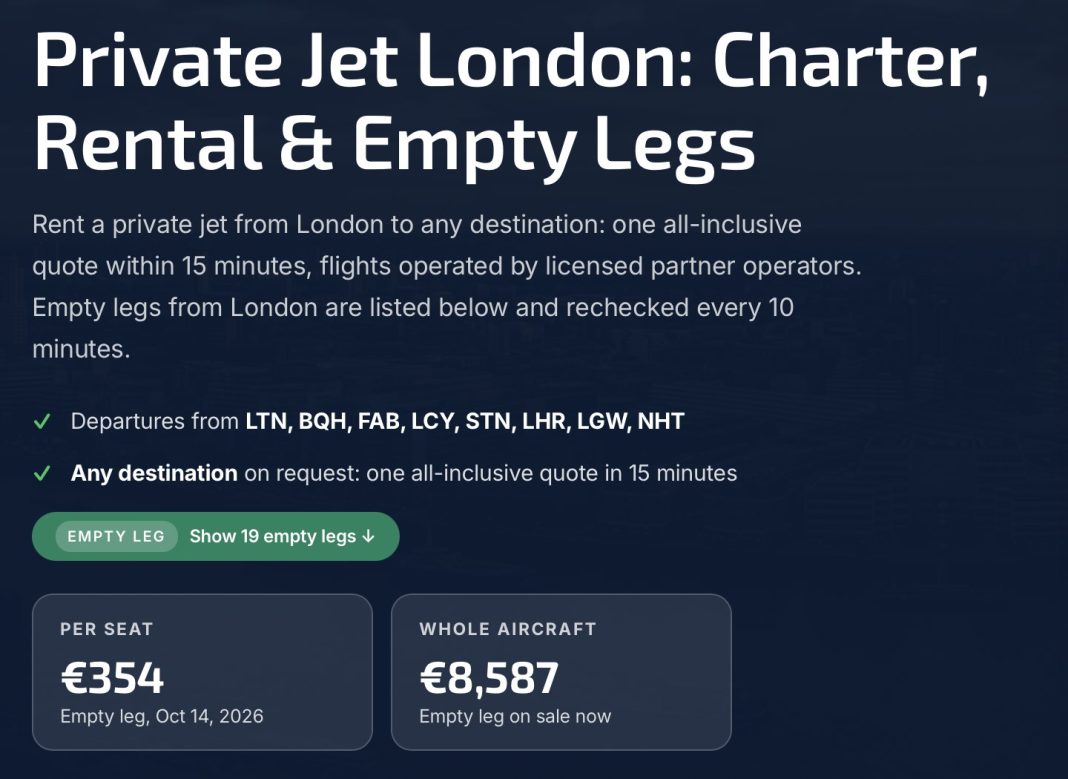
London has several airports capable of accommodating private aircraft, but choosing between them involves more than finding the nearest runway. A passenger departing from Mayfair for a meeting in Geneva may have different priorities from a family travelling from Surrey to the Mediterranean. Ground transport, aircraft suitability, airport operating hours and departure arrangements can all affect the journey. Even a relatively short flight can become inconvenient if the airport is poorly matched to the traveller’s location or schedule.
The capital’s private aviation network includes dedicated business aviation airports and larger commercial airports that also handle private flights. Farnborough and Biggin Hill are established choices for executive travel, while Luton provides extensive private aviation facilities alongside scheduled airline operations. London City, Stansted and other airports offer additional possibilities, although access can depend on aircraft type and operational restrictions. Understanding these differences helps travellers make an informed decision before requesting a quotation.
For passengers considering private jet hire London (rentjet.eu/private-jet-london), airport selection should be part of the initial booking enquiry rather than an arrangement made after choosing an aircraft. A charter provider can compare suitable departure points, taking account of the proposed route, passenger numbers and aircraft availability. This may reveal alternatives that are more practical than the airport originally requested. The best option is generally the one that provides a convenient and reliable overall journey, not necessarily the shortest flight time.
London Luton and Its Private Aviation Facilities
London Luton Airport is an important departure point for business aviation, combining substantial airport infrastructure with facilities dedicated to private aircraft. Located north of the capital, it can be a practical choice for passengers travelling from parts of north and central London, Hertfordshire and the surrounding area. Its established aviation services accommodate a variety of business aircraft, including larger jets used for international journeys. The airport’s role in both commercial and private aviation means that charter operators must coordinate their movements within a busy operating environment.
Private passengers generally use specialist handling facilities rather than following the same departure process as scheduled airline customers. These facilities, commonly known as fixed-base operators or FBOs, coordinate services such as passenger reception, aircraft handling and ground transport. Depending on the provider and the arrangements available, passengers may have access to private lounges and dedicated boarding procedures. The precise services should be confirmed before departure, particularly when privacy or a tight travel schedule is a priority.
Luton’s location is worth evaluating carefully. Although the airport is accessible from central London, road conditions can have a considerable effect on transfer times, especially during the morning and evening peaks. Travellers based in north London may find it more convenient than airports to the south or west, while those starting in Surrey or Kent could face a substantially longer journey. Aircraft availability may nevertheless make Luton attractive even when another airport is geographically closer.
The final decision should take account of ground transport arrangements, airport charges and the proposed departure time. A suitable aircraft already positioned at Luton could offer advantages over one that must be flown to another airport. Conversely, a departure point requiring a lengthy road transfer may offset some of the time saved by flying privately. Evaluating the complete itinerary gives a more realistic picture of the airport’s suitability.
Farnborough and Biggin Hill for Business Aviation
Farnborough Airport in Hampshire is one of the United Kingdom’s principal business aviation airports. Unlike large commercial hubs, its operations are focused on private and corporate aircraft, with facilities designed around the requirements of charter passengers and aircraft operators. Its location southwest of London makes it particularly relevant for travellers based in Surrey, Hampshire and western parts of the capital. Passengers travelling from central London should also consider road conditions and the time required to reach the airport.
Farnborough accommodates a broad range of business aircraft and provides specialist passenger handling services. Its facilities support international journeys, including flights requiring larger aircraft and more extensive operational arrangements. For travellers who value discreet departures and dedicated business aviation infrastructure, it can be an appealing option. However, the airport has operating restrictions, and proposed flight times must be checked against current permissions and available departure arrangements.
London Biggin Hill Airport serves a different geographical area. Situated in the borough of Bromley, southeast of central London, it is a convenient alternative for some passengers travelling from Kent, south London and the eastern side of the capital. The airport concentrates on business and general aviation and offers dedicated handling facilities for private passengers. Its location can also be useful for business travellers heading towards Canary Wharf, although the most convenient transfer depends on the starting address and traffic conditions.
Biggin Hill operates within defined opening hours and noise restrictions, which can influence the suitability of a particular itinerary. Aircraft performance and runway requirements must also be considered before confirming a flight. These limitations do not prevent the airport from accommodating many business jets, but they demonstrate why airport and aircraft selection cannot be treated as separate decisions.
Farnborough and Biggin Hill offer a useful comparison because both specialise in private aviation while serving different parts of the London area. Travellers should consider their location, intended departure time and aircraft requirements rather than assume that one airport is universally preferable. A charter provider can assess the practical advantages of each and identify whether the proposed journey can be accommodated under the applicable operating conditions.
Other London Airports Worth Considering
London City Airport offers a distinctive location close to Canary Wharf and the financial districts of east London. Its proximity to major business destinations can be attractive for travellers whose schedules leave little room for extended ground transfers. However, the airport’s runway characteristics and operating procedures impose specific requirements on aircraft and operators. Not every business jet is approved to use London City, making aircraft compatibility an essential consideration before booking.
Stansted is another possibility for private aviation, particularly when aircraft availability or the passenger’s starting location makes it convenient. The airport handles substantial commercial traffic alongside private and business aircraft, with specialist services available for charter operations. Its position northeast of central London may suit passengers travelling from Essex, Cambridge or surrounding districts. As with Luton, the relationship between road access and the proposed departure time deserves careful assessment.
Heathrow and Gatwick are sometimes considered for private aircraft, but their extensive scheduled airline operations and airport coordination requirements can make them less straightforward choices for ordinary charter journeys. Available slots, handling arrangements and operating costs must be evaluated before either airport can be recommended. London Northolt may also be relevant for certain flights, although civilian operations are subject to particular permissions and restrictions. These airports should therefore be treated as potential options rather than interchangeable alternatives to dedicated business aviation facilities.
Several practical factors help distinguish London’s airport choices.
- Starting location. The distance and expected road journey from the passenger’s home, office or hotel can outweigh small differences in flight duration.
- Aircraft compatibility. Runway characteristics, aircraft performance and local operating requirements determine which jets can use an airport.
- Operating hours. Some airports impose evening, weekend or overnight restrictions that may affect the requested schedule.
- Handling facilities. Private terminals, passenger lounges, customs arrangements and ground transport services vary between locations.
- Charter availability and cost. The position of the selected aircraft, airport charges and positioning requirements can influence the final quotation.
These considerations are particularly relevant when planning journeys with several passengers or multiple destinations. A departure airport that works well for one itinerary may be unsuitable for another, even when the passenger’s starting address remains unchanged. Flexibility over nearby airports can also increase the available aircraft options. It is therefore worth discussing alternatives before committing to a specific departure point.
How to Choose the Most Convenient Departure Point
The most useful starting point is the passenger’s actual address rather than the name of the nearest airport. A traveller staying in central London might initially prefer London City because of its location, but a suitable aircraft may be more readily available at Biggin Hill or Luton. Someone departing from Surrey may find Farnborough considerably more practical, particularly when travelling with family members or substantial luggage. For passengers based in the eastern suburbs, the comparison could favour Biggin Hill or Stansted.
Door-to-door journey planning should include the estimated road transfer, recommended arrival time and any expected airport procedures. Private aviation can reduce the time spent at the airport, but passengers should not assume that every facility provides identical boarding arrangements. International departures still involve security procedures and any applicable immigration requirements. Accurate instructions from the operator or handling agent are essential, especially when the journey involves an unfamiliar airport.
The proposed destination also affects airport selection. Some European airports have restrictions on aircraft types, opening hours or international arrival arrangements, requiring the charter operator to coordinate both ends of the flight. A suitable departure airport in London must therefore be considered alongside the destination airport and the aircraft’s operational capabilities. For longer international journeys, range and payload requirements may further narrow the available aircraft choices.
Passengers should also compare quotations with a clear understanding of the services included. Airport handling fees, aircraft positioning and ground transportation may affect the overall cost, even when flight durations are similar. A lower charter quotation is not necessarily the better option if it requires an expensive transfer or forces the group to leave significantly earlier than planned. Comparing the total journey rather than the airborne portion alone gives a more useful basis for deciding between offers.
London’s range of private aviation airports is an advantage, provided that each option is evaluated according to the journey being arranged. Farnborough offers dedicated business aviation facilities southwest of the capital, Biggin Hill serves the southeast, and Luton provides another established departure point north of London. London City and Stansted broaden the possibilities, subject to aircraft suitability and operational conditions. Choosing the right airport means balancing location, timing, aircraft availability and cost so that the journey works efficiently from departure address to final destination.